Nibbles

New Website!

Check out the new website at: www.GrooverNutrition.com

2015/02/img_2819-0.jpg

Nibbles

GNC, Target, Wal-Mart, Walgreens accused of selling adulterated ‘herbals’ – The Washington Post

GNC, Target, Wal-Mart, Walgreens accused of selling adulterated ‘herbals’ – The Washington Post.

Nibbles

Have You Ever Wondered What the Difference Is Between A Registered Dietitian and a Nutritionist?

6396bf52eb744bf5e52811d59e737506Registered Dietitians (RDs) or Registered Dietitian Nutritionists (RDNs) are food and nutrition experts who have met specific education, practice and exam requirements. In addition to holding a bachelor’s degree, an RDN must fulfill a specially designed, accredited nutrition curriculum; pass a rigorous registration exam; and complete an extensive supervised program of practice at a health-care facility, foodservice organization or community agency. Specific details are below:

• Completed a minimum of a bachelor’s degree and coursework through an Accreditation Council for Education in Nutrition and Dietetics (ACEND) accredited Didactic Program in Dietetics (DPD) or Coordinated Program in Dietetics (CP). Dietetics students study a variety of subjects, including food and nutrition sciences, biochemistry, physiology, microbiology, anatomy, chemistry, foodservice systems, business, pharmacology, culinary arts, behavioral social sciences and communication.

• Completed 1200 hours of supervised practice

• Passed a national examination administered by the Commission on Dietetic Registration (CDR).

Some RDs or RDNs hold additional certifications in specialized areas of practice, such as pediatric or renal nutrition, sports dietetics, oncology, gerontological, nutrition support and diabetes education.

All states accept the RD or RDN credential for state licensure purposes, but some require additional licensure (LD).

So, what is a nutritionist?

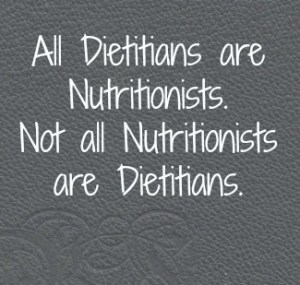
The term nutritionist is not a regulated title. Anybody can call themselves a nutritionist, but only people who have gone through the RDN education & training and have passed the national exam can call themselves an RDN.  This is not to say that nutritionists are not full of nutrition knowledge and experience. This does mean that you need to question their skills and experience before taking advice. Some nutritionists may have completed the didactic portion of their education and just did not go on to finish their internship and exam. However, be careful of some nutritionists with no education or experience. Do your research before taking advice.

What are the benefits of seeing a Registered Dietitian Nutritionist?

Personally tailored advice: After learning about your health history, favorite foods, eating, and exercise habits, an RDN will help you set goals and prioritize. Follow-up visits will focus on maintenance and monitoring your progress.

Help managing chronic diseases: If you have high cholesterol, high blood pressure, diabetes or cancer, it can be hard to know what to eat. An RDN can review your lab results with you, help you understand your condition and provide education about the nutrients that affect it. Then, he or she will help you create an eating plan that includes all the important nutrients that can help you manage your condition.

Guidance navigating food allergies, sensitivities and intolerances: When you suffer from conditions like celiac disease, food allergies or lactose intolerance, it’s easy to be overwhelmed by what you think you can’t eat. That can translate into a boring diet, and may even lead to nutrient deficiencies. An RDN can teach you how to read food labels so you’ll know which ingredients to avoid, and help you find substitutions to keep your diet balanced and tasty, too.

A weight management program that really works:
A registered dietitian nutritionist will partner with you to develop a safe, effective weight management plan that you can stick with for the long haul. To guide and motivate you, an RDN will use creative strategies to help with meal planning, grocery shopping, food journaling and mindful eating.

Information obtained from www.eatright.org. Please check out their website for more information on nutrition, the benefits of hiring RDN’s and how to become an RDN.

If you are looking for a RDN, please check out www.GrooverNutrition.com to see how we can help you with your nutrition needs! Look at the Services page to see some of the services offered to you!

Nibbles

Paleo Crockpot BBQ Pork

Happy Sunday! In support of all of you Crossfit Ex’ers doing the Paleo Challenge this month, here is a recipe you should try out! I am pretty picky about BBQ, and this turned out really well. I love the apple cider vinegar flavor and this recipe gives enough for leftovers all week!

075

Serving Size: 3-4oz pork with sauce

Ingredients:

1 tsp olive oil

Crockpot Paleo BBQ Pork

1 small onion, chopped

6 cloves garlic, crushed

16oz Boston Butt

14.5oz can stewed tomatoes

0.5 cup tomato sauce

0.5 cup apple cider vinegar

0.25 cup tomato paste

Pepper, to taste

Instructions:

Sautee onions and garlic in olive oil until tender.

Sear pork butt in onion & garlic mixture.

Add all ingredients to crockpot.

Cook on low for approximately 8 hours.

Enjoy!


Nibbles

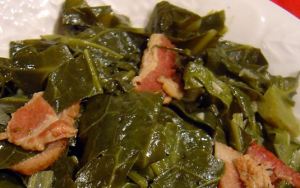
New Years’ Day Collard Greens

Happy New Years everybody! Hope you all enjoyed a relaxing day and I hope that you all ate your black-eyed peas and collard greens!  Even if it is a superstition, I will take some extra good luck and money for 2015! If you are like me, you love a flavorful Southern collard green recipe.  Hopefully, this one will not disappoint.

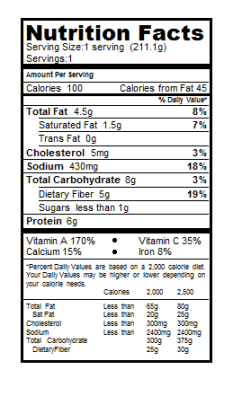
New Years Day Collard Greens

Serving size: 1/2 cup
collard-greens

Servings per recipe: app. 8

Ingredients:

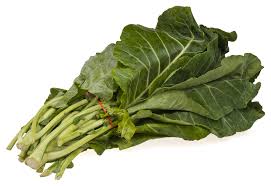
1 bunch (app. 2 lbs) collard greens

2 cups chicken broth

3/4 cup apple cider vinegar

6 slices uncured bacon, cut into small pieces
New Years Day Collard Greens nfl

1/2 cup diced onions

5 cloves crushed garlic

1/2 tsp crushed cayenne pepper

salt and pepper to taste

Instructions:

1. Cut bacon into small pieces.

2. In a large stockpot, fry bacon until crisp tender.

3. Add diced onion and garlic and saute until clear.

4. Add cayenne pepper, apple cider vinegar and chicken broth.

5. Cut collards into desired size and add to stockpot.

6. Simmer for approximately 1.5 hours (this will allow the stems to be tender and the leaves to be soft yet not mushy).  Of course, cook for longer for more tender.

7. Enjoy and Happy New Years!